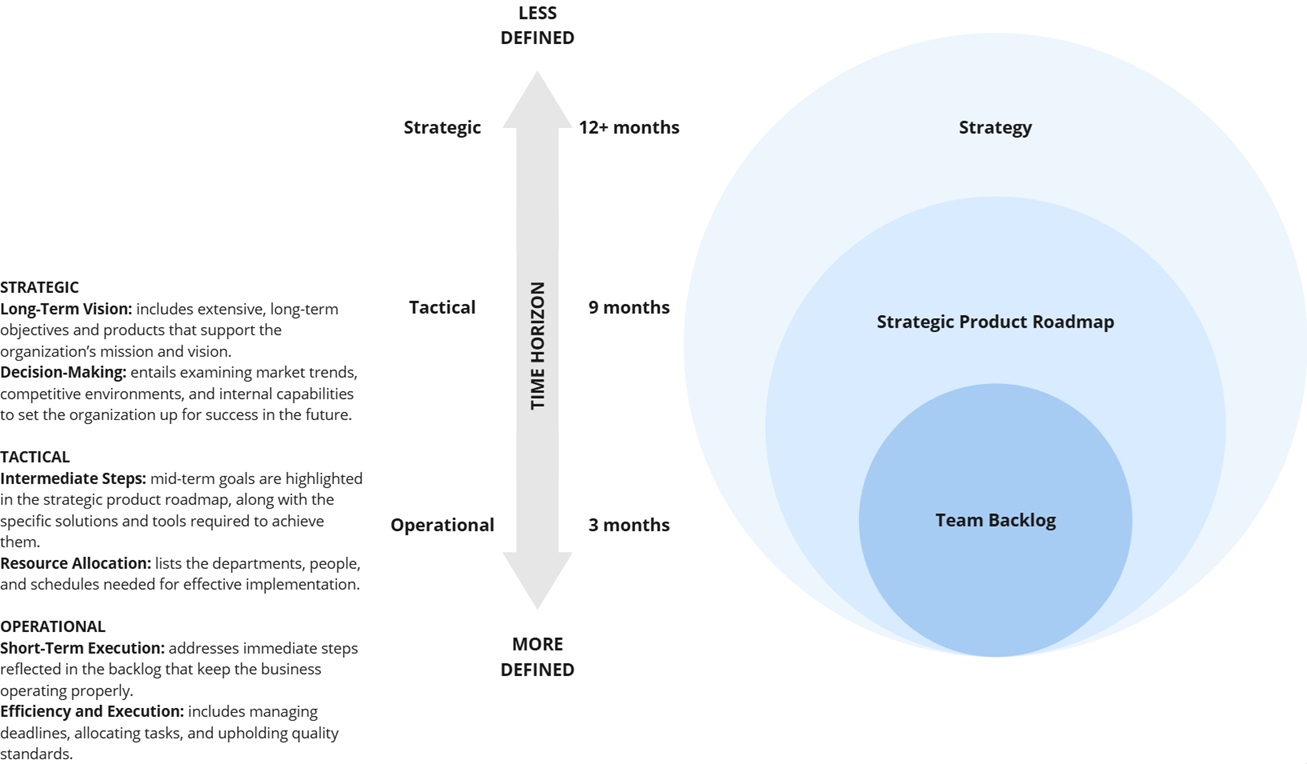
Most product roadmaps fail because they focus on what will be built, but ignore why it matters and how it will be delivered at scale. A strategic product roadmap fixes this by connecting business outcomes (why) with clear initiatives (what) and the architecture runway and technology direction (how) needed to enable them across the next 3–4 PIs. Instead of acting as a static plan, it becomes a practical decision framework that helps Product Owners align stakeholders, prioritize effectively, and translate strategy into coordinated, executable work that delivers measurable value.

Translate strategy into actionable initiatives
Translating strategy into actionable initiatives is where a roadmap becomes useful for delivery, not just direction. Strategy is often too abstract to execute, so Product Owners must turn it into clearly defined initiatives that teams can understand, plan, and break down into backlog-ready work. This step creates a shared bridge between intent and execution, ensuring that multiple teams move in the same direction instead of solving problems in isolation.
- From abstract goals to concrete initiatives – Reframe broad objectives (e.g. “improve UX consistency”) into specific initiatives (e.g. “standardize components, unify navigation, define design tokens”).
- From initiatives to executable work – Decompose initiatives into epics and features that can be directly reflected in team backlogs and planned across PIs.
- From isolated tasks to coordinated direction – Ensure initiatives are cross-cutting and aligned across products, so teams contribute to shared outcomes rather than fragmented improvements.
Focus: Convert each strategic (direction) goal into roadmap initiatives and break them down into epics (or features) that can be added to the backlog.
Align delivery with business outcomes
Aligning delivery with business outcomes ensures that teams focus on creating measurable value, not just shipping features. A strategic roadmap makes this explicit by linking every initiative to a clear purpose, expected impact, and success metric. This shifts the conversation from “what are we building?” to “what are we achieving?”, helping Product Owners prioritize effectively and avoid low-impact work.
- From outputs to outcomes – Define the expected result of each initiative (e.g. increased adoption, reduced effort, faster delivery), not just the feature being delivered.
- Tie work to measurable success – Connect initiatives to concrete KPIs or signals, so progress can be evaluated beyond completion.
- Prioritize based on impact – Use outcomes to decide what to do first, focusing on initiatives that deliver the highest business value rather than the loudest requests.
Focus: Define one measurable outcome for every roadmap initiative before bringing them to a PI.
Prioritize and sequence work across PIs
Prioritizing and sequencing work across PIs ensures that delivery is focused, realistic, and unblocked, rather than reactive and overloaded. A strategic roadmap helps Product Owners decide not only what is important, but what should happen first, what can wait, and how work should flow over time, balancing business priorities with dependencies and technical readiness. This creates a clear path from strategy to execution while keeping flexibility in later PIs.
- Prioritize based on value and constraints – Balance business impact, dependencies, and technical feasibility to decide what truly deserves focus in each PI.
- Sequence for flow, not urgency – Plan work so that foundational elements (e.g. research, architecture runway) come before dependent features, avoiding rework and delays.
- Keep future PIs adaptable – Define near-term work clearly, but leave later PIs at a higher level to allow learning and adjustment without overcommitting.
Focus: Order roadmap initiatives based on value, dependencies, and technical readiness – and explicitly decide what will not be done now.
Connect strategy to execution and communication
Connecting strategy to execution and communication ensures that everyone – from leadership to delivery teams – is aligned on where the product is going, why it matters, and how work translates into results. A strategic roadmap acts as a shared reference point that links high-level goals with day-to-day activities, while also providing a clear narrative for stakeholders. This reduces misalignment, improves decision-making, and keeps teams focused on delivering meaningful outcomes.
- Create a shared understanding – Present initiatives in a way that is clear for both business and technical stakeholders, so everyone aligns on priorities and direction.
- Bridge planning and delivery – Ensure roadmap initiatives are directly connected to epics and backlog items, making strategy actionable for teams.
- Communicate intent, not just status – Use the roadmap to explain why work is prioritized and what value it will bring, helping manage expectations and build trust.
Focus: Ensure every roadmap initiative is linked to backlog items and can be clearly explained to both stakeholders and teams in one sentence.
Sync with the architecture runway
Synchronizing with the architecture runway ensures that product plans are technically feasible, scalable, and not blocked during delivery, even though Product Owners do not own the architecture itself. While the System Architect defines and evolves the runway, Product Owners must actively connect roadmap initiatives with the required technical capabilities, so that features are delivered on top of a ready foundation rather than being delayed or compromised.
- Ensure visibility of dependencies – Identify which initiatives depend on specific architectural capabilities (e.g. APIs, design systems, data models) and make these dependencies explicit in the roadmap.
- Align timing with technical readiness – Coordinate with the System Architect so that the necessary runway elements are planned and delivered before or alongside dependent features.
- Facilitate continuous collaboration – Maintain regular alignment with architecture stakeholders to validate feasibility, adjust sequencing, and avoid disconnects between product ambition and technical reality.
Focus: For each roadmap initiative, confirm with the architect what technical enablers are required and when they will be ready.
In short
A strategic product roadmap is not just a plan of what will be built, but a coordinated framework that aligns business outcomes, product initiatives, and technical readiness over time. For Product Owners, its role is to ensure that work is driven by value, translated into actionable initiatives, properly prioritized across PIs, clearly connected to execution, and synchronized with the architecture runway owned by System Architects. When used effectively, the roadmap becomes a shared decision-making and communication tool that links strategy to delivery and ensures that what teams build is both meaningful and feasible.
Dictionary
(Strategic) Goal: A desired business outcome the organization wants to achieve.
(Roadmap) Initiative: A high-level investment area that defines how a goal will be pursued.
Epic: A large, value-driven piece of work that delivers a specific capability and can be broken into smaller items.
Feature: A specific functionality or capability that provides value to users or systems.
Story: A small, implementable unit of work describing a user need or system behavior.
| Level | Focus | Belongs to | Granularity |
| Goal | Why (outcome) | Strategy | Very high (Long-term) |
| Initiative | What / Why (direction) | Roadmap | High (Multiple PIs) |
| Epic | What (deliverable) | Backlog (bridge) | Medium (Multiple PIs) |
| Feature | What (detailed) | Backlog | Lower (One PI or less) |
| Story | How (execution) | Backlog | Very low (One iteration) |
References
[1] C. Todd Lombardo, Bruce McCarthy, Evan Ryan, Michael Connors, “Product Roadmaps Relaunched,” O'Reilly Media, October 2017.
[2] Scaled Agile Framework (SAFe), “Roadmap,” URL: https://framework.scaledagile.com/roadmap/, Last Update: 25 February 2025.
[3] Marty Cagan, “Inspired: How to Create Tech Products Customers Love,” Wiley, 2017.